
Research
I study the evolutionary and developmental origins of health and disease through computational genetics. The placenta sustains fetal development by coordinating resource exchange and signaling between mother and offspring. This makes it a compelling system for studying how partly shared and partly divergent genetic interests interact with environmental conditions during pregnancy. Understanding its regulation can help explain how prenatal conditions relate to variation in growth and later health.
My program connects the evolutionary origins of placental gene regulation with its responses to prenatal environments. I ask whether mechanisms involved in regulatory innovation—including imprinting, transposable-element-derived sequences, and alternative splicing—also help explain variation in environmental sensitivity. I combine comparative and family-based genetics with isoform-resolution functional genomics to trace these connections from regulatory variation to molecular function and developmental outcomes.
How do prenatal environments reshape placental gene regulation and offspring health?
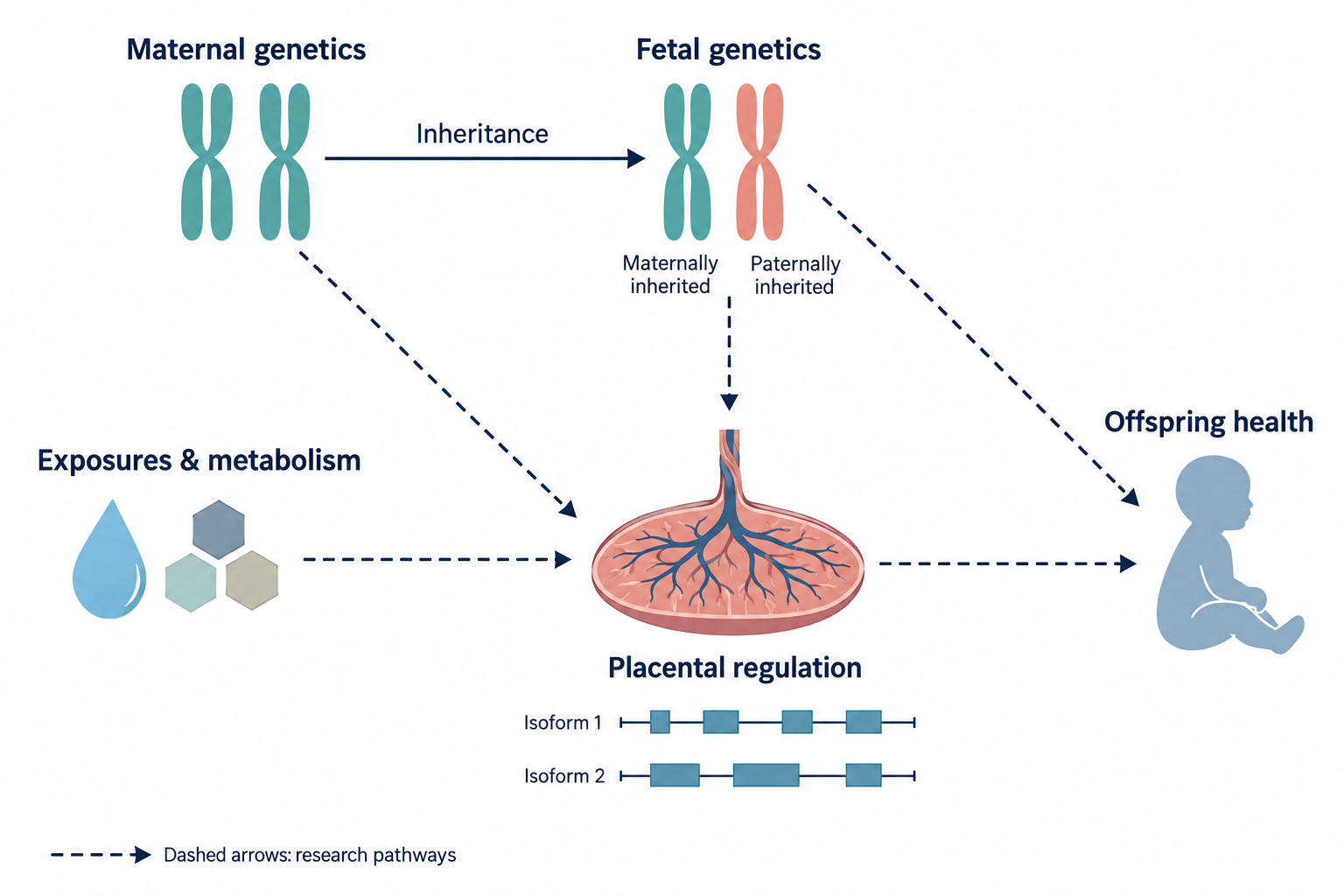
I investigate how maternal exposures, metabolic conditions, and genetic variation shape the prenatal environment, placental gene regulation, and offspring health. My placenta-specific long-read transcriptome reference provides a foundation for resolving individual transcript isoforms and regulatory changes that gene-level summaries can obscure. I am building multi-ancestry regulatory maps to examine how PFAS exposure, gestational diabetes, and maternal obesity relate to placental expression and parent-of-origin regulation.
A complementary question is how maternal genetic influences acting through pregnancy differ from variants inherited by the child. I am developing family-based analyses using transmitted and non-transmitted alleles to separate these pathways, with an interest in neurodevelopment and childhood cancer. I develop ICONIC to assess causal assumptions in observational multi-omics using genetic instruments and negative controls. Alongside these analyses, I am developing functional follow-up strategies in placental organoids to test candidate regulatory mechanisms. The goal is to distinguish regulatory changes that accompany exposure from those that may mediate its effects on development.
Selected work
- Long-read assembly of the placental transcriptome — Nature Communications, 2026
- Transplacental PFAS transfer and placental transcriptional networks — Environmental Health Perspectives, 2026
- ICONIC: causal-inference methods and diagnostics for multi-omics — preprint, 2026; software
Related cancer genomics and methods
- Isoform-level analyses of six cancers — British Journal of Cancer, 2025
- Long-read transcript assemblies and breast cancer risk — preprint, 2026
- Quantification, eQTL replicability, colocalization, and TWAS — Nature Genetics, 2026
How does evolutionary conflict shape gene regulation in nutritive tissues?
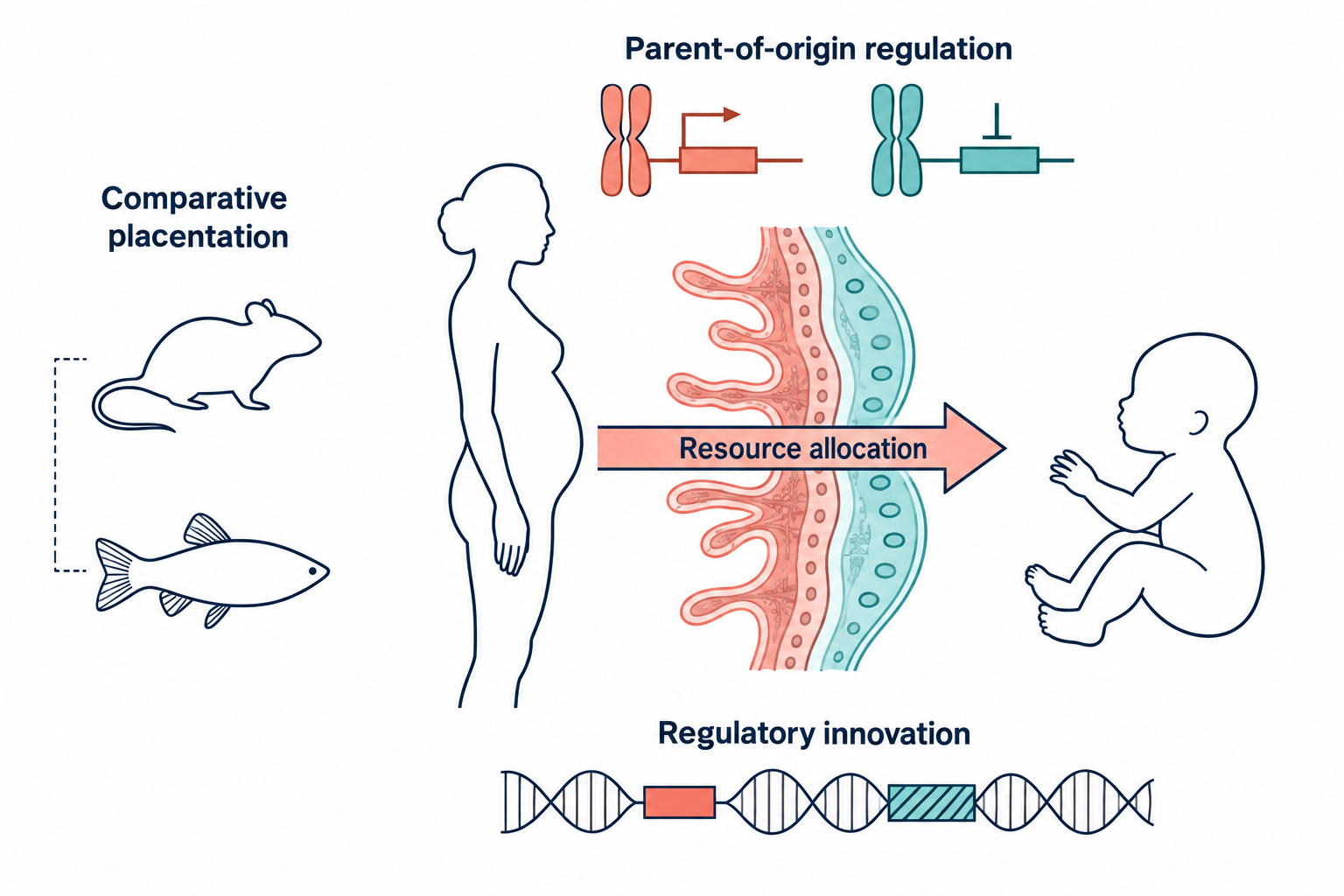
Nutritive tissues mediate resource transfer between mothers and offspring, creating a setting in which parental genetic interests can diverge. I investigate how this conflict shapes gene regulation in animals, focusing on placental mammals and comparative questions across taxa. Independent origins of placentation provide a way to ask whether similar resource-allocation problems recruit similar regulatory mechanisms. I examine how parent-of-origin regulation and transposable-element-derived sequences contribute to these systems.
From social behavior and reproductive division of labor in eusocial insects to maternal–offspring resource allocation in placentas, I study how parental genomes shape gene regulation and development. I combine reciprocal crosses, allele-specific genomic analyses, isoform-resolution genomics, and comparative regulatory analyses to examine how evolutionary conflict shapes regulatory variation. I ask how the evolutionary histories of these regulatory systems relate to their responsiveness to environmental conditions during development.
Selected work
- Intragenomic conflict and queen–worker caste determination — Genome Biology, 2025
- Kinship theory and variation in altruistic behavior — Molecular Ecology, 2023
- Parent-of-origin effects in honey bee aggression — BMC Genomics, 2023