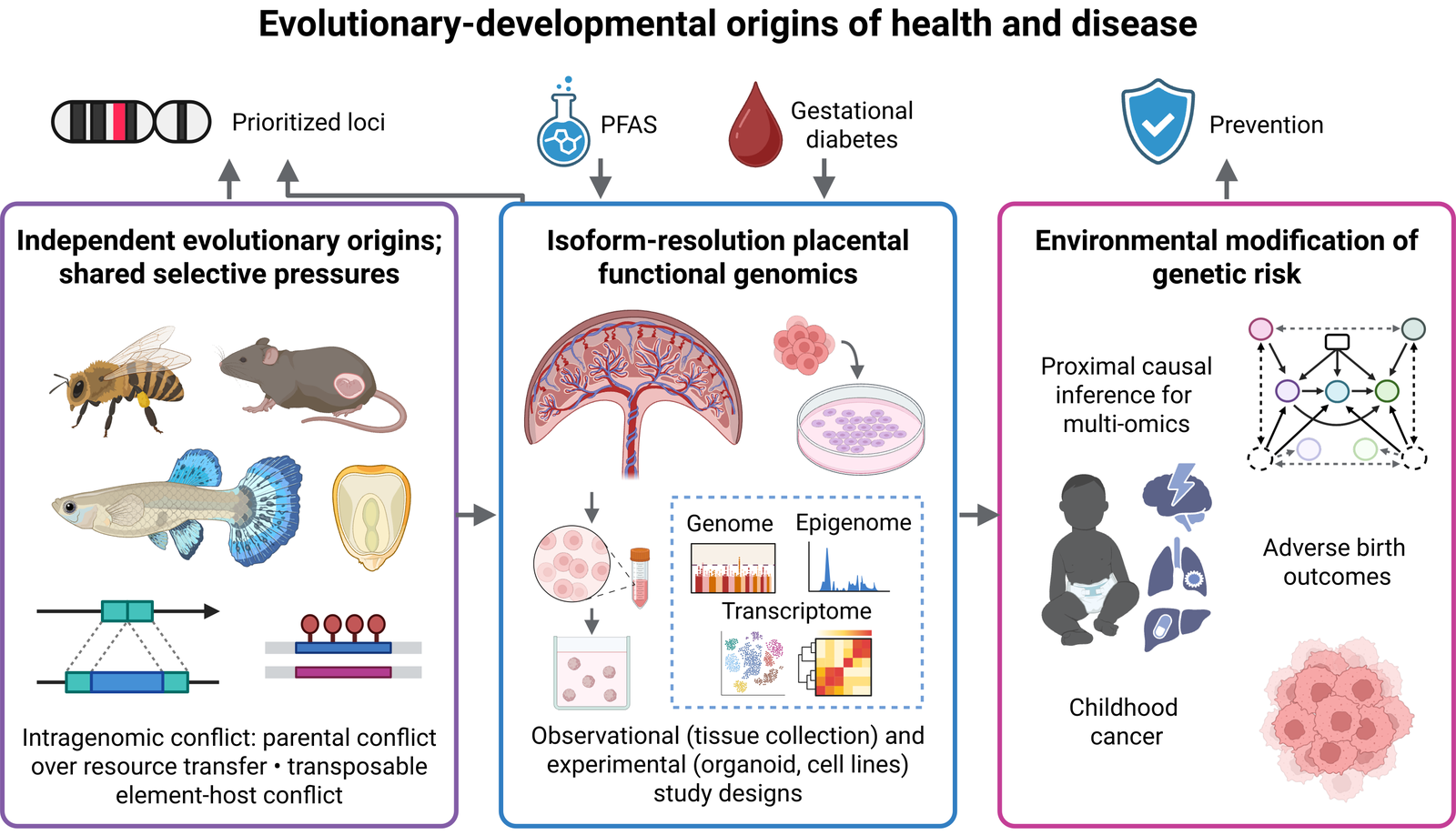
I am an Associate Data Scientist in the Department of Epidemiology at the University of Texas MD Anderson Cancer Center with Dr. Arjun Bhattacharya and Dr. Paul Scheet. The organizing question of my research is: how does the placenta’s isoform-resolved transcriptional landscape — shaped by both genetic variation and environmental exposures — mediate the programming of offspring health?

My work approaches this from three interconnected angles. First, I build the tissue-specific molecular resources needed to study the placenta at the right resolution, using long-read RNA sequencing to characterize transcript-isoform diversity that is invisible to standard gene-level approaches and missed by annotations derived from adult tissues. Second, I develop the causal inference tools needed to study developmental programming rigorously in observational birth cohorts, including novel frameworks that leverage multi-omic negative controls, genetically-predicted expression as instrumental variables, and generative models to calibrate confounding bias. Third, I functionally validate computationally prioritized candidates in experimental systems: isoform-specific knockdown in trophoblast cell lines, and patient-derived placental explant and organoid models in collaboration with faculty across institutions to test how candidate isoforms respond to glycemic and exposure conditions in physiologically relevant contexts.

I apply these tools to two primary exposures where the placenta is the obligate biological intermediary. In the context of gestational diabetes, I am building the largest multi-ancestry placental isoform-level dataset to identify how maternal hyperglycemia alters placental isoform landscapes across diverse populations, and testing causal pathways linking these molecular responses to fetal growth and childhood metabolic risk. In the context of PFAS, I am investigating how prenatal exposure disrupts placental genomic imprinting and parent-of-origin isoform regulation, and how transcriptional network architecture — rather than individual differentially expressed features — mediates effects on perinatal outcomes and offspring neurodevelopment. Ongoing work includes a large multi-cohort placental eQTL and colocalization study linking isoform-level genetic regulation to birth and early-life outcomes.

The long-term translational goal of this program is developing placental isoform signatures into early-pregnancy maternal blood-based screens that can identify at-risk pregnancies and inform targeted interventions during critical developmental windows, before complications manifest clinically.

I am currently seeking tenure-track Assistant Professor positions. See my CV for more details.